Showing posts with label poverty. Show all posts

Sunday, October 16, 2011

Stat Attack


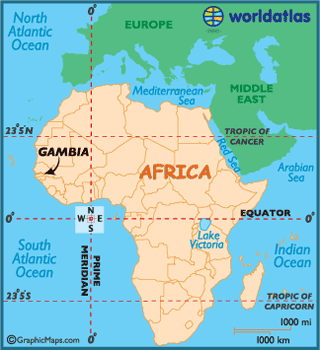
I think it’s high time that I write some introductory information about The Gambia, so that you all have a bit of a better idea as to what life is like out here. According to the United Nations:

The Gambia is ranked 151 out of 169 countries on the Human Development Index


The average per capita income over a year is approximately $400 (about £250).

Poverty is increasing – in 2003 59% were classed as “poor”, living on less than $1 a day. Now 61% live on less than $1 a day.

The mean length of schooling stands at 2.8 years.

25% of women are literate, compared to 48% of men.

65% of the population have access to safe water.

Youth (0-25 years old) makes up approximately 60% of the population. 40% of the youth of working age are unemployed.


As one can see, The Gambia faces many challenges. There is a lot of work to be done to help ensure that Gambians have the same life opportunities and access to education that other nations enjoy. Organisations such as the World Bank and the International Monetary Fund have been active in The Gambia for many years, but as one can see the levels of poverty have actually increased under their watch. Policies, such as the setting of a 24% interest rate (as stipulated by the World Bank), have often been seen as misguided, leading to calls from development charities for a re-think.

So what else for this week’s blog entry?

National Volunteering Network – whilst my work is primarily with the Ministry of Education, I’m also starting to become involved with Gambia’s national volunteering network (something I should be able to contribute to, having worked with a similar kind of network in Mongolia). The Network is in its infancy, but is hoping to do a variety of things to promote volunteerism in Gambia. The Red Cross, the UN and some small Gambian organisations are aiming to jointly organise an event for International Volunteers’ Day on December the 5th. Watch this space...

Blackout at the Office - I guess the main thing that characterised this week for me was the five day power cut that we faced in my workplace. As a result, pretty much all work stopped in my department (the work of about 30 people). I do not feel like I should discuss the details of exactly why we’ve had a lack of electricity over the internet, but anyway – this is a good example of some of the problems that a developing country faces. It’s frustrating, but also a good educational experience for me. I just hope that power is back in time for next Monday!

Lots of love and a big hug to you all, take care and have a good week ahead,

Robert

Monday, October 3, 2011

Dinner by Candlelight anyone?

The last week has been punctuated by many power cuts. Every single one of the last seven evenings I’ve been treated to a clear view of the stars, as all the artificial, electric lights in the neighbourhood have been off. It’s quite surreal to have complete darkness in the middle of a city. I took a walk around my local streets and could see little candle lights through people’s windows, it's really quite beautiful. My own home is awash with candles at the moment, I’m trying my best to create a nice atmosphere in the evenings. It all feels quite romantic - that is until I spot the lizard that’s sat next to me...

Power cuts are a common feature out here in the Gambia, and a good way of seeing the poverty divide. Anyone who can afford it buys a back-up electricity generator that runs on petrol, so for them the impact of power cuts is minimal – one just takes a short walk to the generator, flicks a switch and normal service resumes. For the rest of us plebs (myself and 95% of the population) we are faced with regular power cuts at work and at home. I quite enjoy evenings by candlelight, but I’m sure the locals would prefer something a little bit more reliable...

My work - So, what exactly am I supposed to be doing here? Well, my job is to help the Ministry of Education with a project that uses national (Gambian) volunteers to fill gaps in secondary schools. The Ministry recruits newly trained graduates and places them in rural schools for an academic year. Rural schools are in particular need of help as they are understaffed. Going to a rural location often entails a drop in living standards (some locations still don’t have electricity or running water) and the distance from friends and family can be tough, thus it is not a popular choice for teachers. Having said that, the Ministry allocates all teachers to schools every three years, so teachers often have no choice where they go! In theory this may sound like a good solution to addressing the teaching gap in the countryside. In reality, however, as soon as teachers find out they are going to a rural school many of them quit their job!

So if going to the countryside is such a tough option why are these young volunteers interested? Well, many of them seem keen to give something back to the nation. Some feel that they are the privileged few, those who managed to get to university. Thus they are keen to give one year of their lives back to The Gambia in order to help other young people get access the same levels of education. Two of the volunteers have separately quoted John F. Kennedy's words “ask not what your country can do for you, but what you can do for your country” back to me. Other volunteers are keen to see what life is like in the countryside, having spent their whole lives growing up in the more developed Kombos.

The idea of the project is very good, and the work we’re doing should prove useful as other organisations and government departments gradually start to use national volunteerism in their work. However, it is clear that this work will be difficult for me! Things move frustratingly slowly here... Fingers crossed I’ll be able to overcome this, and the other challenges that may present themselves, so as to make a difference. Wish me luck!

Local music – whilst not necessarily my “cup of tea”, Gambians seem to be very much into reggae, hip hop and Senegalese music. This is the soundtrack to my minibus journeys around the city; every taxi driver seems to let the day pass him by with large doses of reggae beats. One day at work I decided to check exactly how popular Western music was, and asked how many people knew The Beatles. Nobody. Elvis Presley? Nope. It never ceases to astound me how in some part of the world The Beatles are so ingrained into musical culture (e.g. in Mongolia they were massive – Ulaanbaatar has a monument dedicated to them), whereas in other they are completely unknown. Bizarrely enough, my office all seemed to know the obscure 90s pop sensation Whigfield though...

A big hug and lots of love from The Gambia, take care of yourself,

Robert