Showing posts with label Islam. Show all posts

Thursday, January 12, 2012

Pros and Cons - Part 2

Following on from last week's post, I'm using this blog entry to focus on some of the positives of life in The Gambia. Enjoy...

Inter-faith relations - This was the first time I lived in a predominantly Muslim country, an experience in its own right. I could go on for hours about poligamy (a widespread practice in The Gambia), or how it felt to have Arabic prayers being the soundtrack to much of my daily life. However, what I'd like to focus on in this blog is one of the success stories for The Gambia - the way in which religions respect each other. Whilst The Gambia is largely Muslim, it is still home to many Christians. One hears a lot about the problems and tensions between religious communities around the world (and even closer to home, in the UK), so I was curious as to how the communities would interact. All the guidebooks state that Gambia is a peace loving nation, in which everyone gets on. I'm delighted to say that generally this seems to be true. Muslims and Christians do get on, and their religion is not a barrier for friendship. Many Christians join their Muslim friends to share in Islamic festivals, and the vast majority of Muslims are happy to join Christians in their celebration on Christmas. There is real friendship there, and a great deal of respect. Gambia has a lot to teach the world in this regard.


Life in the countryside - I'm generally a real sucker for the simple life, and really enjoy time out in the countryside. The Gambian countryside is particularly beautiful, full of flora and fauna. My encounters with crocodiles and monkeys were particular highlights, but really every chance I got to get close to nature was special. It's such a shame that most people's holidays in the Gambia revolve around the beach resorts and the city's bars. If any of you get the chance to go to The Gambia, make sure you go for a trek up country!


Connections - Gambian people really do seem to support each other, and place a lot of importance on friendships and family. Everyone seems to stick together, and much time is spent doing work around the house/compound as a family. People will stop in the street to find out how their neighbours are doing, and if anyone needs help with something the locals will generally rally round. It is a refreshing change from the lack of community that we can sometimes feel in the West. As a toubab I was not able to fully integrate myself into this culture, but it really does seem special from the "outside looking in".


Tapalapas! - my daily bread. I would indulge in a filled "tapalapa" baguette most days, and just thinking of them now makes me start to salivate! My local vendors would provide a range of delicious fillings, from fishballs to spicy beans. The "breakfast bap" of scrambled eggs, onion and stock cube scratchings was a particular favourite. And all for the price of about 30p (approximately half an American dollar). I also developed an unhealthy love of coffee with condensed milk - super sweet and super delicious, but my dentist would not be happy... Whilst living on a Gambian diet for life would not be healthy (vegetables are few and far between), it was actually quite satisfying. I hope a tapalapa shack will open up soon in the UK!


So, many things for me to take back home and ponder about. Thank you Gambia for sharing so much with me! And many thanks to you all for journeying along with me the last few months. Lots of love and a big hug,


Robert

Sunday, November 13, 2011

Very Superstitious?

The topic of this blog is something I’ve been meaning to write about for some time.
A selection of juju bracelets and necklaces
Scratch underneath the surface, and the influence of traditional religions is still present in modern day Gambia. For example, many people wear a variety of bracelets and charms, collectively called jujus.Each juju is supposed to confer upon the wearer different properties, such as extra strength or luck, or even invulnerability to knives and bullets.  I’ve seen babies crawl around with charms attached to their legs, to ward off evil spirits. It’s interesting to see how the “more modern” religion of Islam has been mixed into the juju tradition, with people now wearing bracelets containing parts of the Koran.

Kankorans – another sight that regulars in The Gambia will see are kankorans, spiritual protectors who guard off evil spirits. Kankorans are very easy to spot as they are masked and dressed in menacing costumes, and brandish large machetes (which, despite some Western preconceptions, is not an everyday look in the centre of Banjul!). They often make their appearance at circumcision and child naming rituals; a presence to make sure devils and jinns stay away.

Recently I had my own kankoran experience, and whilst I know it makes me sound silly, I can honestly say I felt something very strange. I was jogging through my neighbourhood and passed a particularly hairy kankoran on the road. He stopped, looked at me and then pointed at my arm. Suddenly, I felt a strange pain in my hand and lower arm. I started to panic a bit, as the pointed hand of the kankoran seemed to be having an effect on me. I politely said goodbye and then rushed along the road, all kinds of thoughts in my head. I then proceeded to ask any bystander I knew “are kankorans good or bad?”.  To my relief, the official explanation is that kankorans are good, and that he was probably trying to ward off evil spirits from me. Anyway, I returned home feeling as if something very strange had just taken place...
Witches – I enjoy exploring the minds of the Gambian friends I have made, and often ask them questions to hear their views about things. A recent topic (due to my own kankoran experience) has been whether magical forces are at work in The Gambia. Many people say they have met witches, and by that they mean evil people who can use magic. A clear sign of a witch, according to the people I have spoken to, is that all the children in their family have died. “The witch obviously stole their life power”. The Western perspective would say that labelling someone a witch during what must be a very traumatic time must be a horrible experience, but nevertheless that’s what goes on in some Gambian villages.
Vampires and Dragons – I was surprised to hear that some Gambians believe in dragons too. I had an in-depth discussion with a driver, who was telling me that dragons come to destroy homes and roads during the heavy rains. If one is unlucky enough to see a dragon, a sort of showdown occurs. Every human and dragon has an Arabic word written on their foreheads (which magically appears during this showdown), and whoever can read their opponent’s word out first survives. Dragons are particularly good at quickly reading out the words, so very few people have actually lived to tell the tale of the dragon’s word challenge.
The driver proceeded to tell me that toubabs (the white people) killed many of the dragons by ingeniously taking mirrors out with them when going to face the creatures. The dragons would see their own face and read out their own Arabic word, thus condemning themselves to death. Clever toubabs!
It’s not only dragons that have been mentioned. I’ve also had a couple of people asking me about whether I’ve seen vampires, as many of the Western films they have seen contain vampires. My serious response causes sadness, as I inform them that I have never seen a vampire. It really is fascinating to explore people's views though, and I love any excuse to share my own interest in folk tales and monsters.
Ok, that's it for this week. Love and best wishes to you all,
Robert

Tuesday, November 8, 2011

Tobaski-Tastic

Sunday was Tobaski, one of the most significant days in the Islamic Calendar. In Gambia, Tobaski is THE big day of celebration, when families get together, eat loads of food and exchange gifts. I was lucky enough to be invited to a gathering with a local Senegalese family I have met. My first duty – to help with the slaughtering of the rams. I’m of the opinion that if I’m prepared to eat meat, I should be prepared to participate in the slaughter of the animals. However, it’s not a particularly pleasant process! Holding down an animal, feeling its last struggles and the last breaths leave its body is a strange sensation. Even more so is just watching a living thing becoming an object, all in under a minute. It really brought home how fragile life is.

After the ritualistic killing had ended, we moved onto the cooking stage. Everyone sat out, preparing the various ingredients for the upcoming feast. I’ve never seen so much garlic chopped, enough to fight a whole army of vampires! Everything is done in a slow and relaxed manner, so food was actually served about 5pm (a long wait since the ram sacrifices at 10am). A huge amount was prepared, but we only ate a third of it. Tradition says that the remaining two thirds should go to neighbours and those too poor to buy food themselves.


All were dressed in their finest traditional clothes, and the chatting and eating went long into the night. Whilst the day had a Muslim feel to it (the day started with mass prayers in the nearby field), most families had Christian friends come to visit. Gambia is a religiously tolerant society, and any excuse for a party is generally well-liked by the population, no matter what religion they belong to!
As evening approached, I made my excuses and wandered back home, happy that I had experienced something new. Things will take a while to get back to normal after Tobaski, as many people have left to visit their families in the countryside. I’ve been told to wait for the radio to announce when I (a government worker) should go back to work. Let’s see how many days holiday I will get...
Many Tobaski wishes to you all, lots of love,
Robert

Saturday, November 5, 2011

There and Back Again

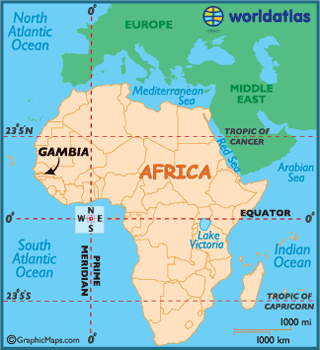
On Wednesday evening I returned back from a great trip to the very end of Gambia, the intriguingly called “Region 6”. My base: Basse, a bustling market town to the very east of the country. My mission: to make a promotional film for the Rural Support Organisation for the Disabled (RSOD). The trip took about four days in total, a time period which included the large 7/8 hour long trek along the rural roads (often punctuated by the many police and army checkpoints). In my round trip I took in about half of Gambia, travelling along the south bank of the River Gambia. Have a look at the map, you can see how I travelled from Banjul all along the south of the river to Basse Santa Su. Whilst we're looking at maps, you might be interested to see that The Gambia is the smallest country in mainland Africa.


Filmmaker Extraordinaire – Upon arrival in Basse I got to work pretty quickly, camera in hand. Whilst I have done filming work in the UK, this was my first proper project in another country, so I was a bit apprehensive as to how it would go. However, the filming was great fun! It led me to meet some really inspiring people and find out about some really great projects that RSOD is running. The staff and volunteers who work there really are hardworking and kind people, many of whom had to get over the difficulties and stigma that their own disabilities present them with. Amongst many things my film will cover the school for the deaf that RSOD runs, the women’s support group, the handicraft workshops they run and the rural support projects they have started. I’ve got to get the film ready for mid-November, and will try to put it up online shortly afterwards. Keep your eyes peeled...
Rob’s Country Bumpkin Thoughts – My trip also offered me a chance to taste a bit of life “up-country”, away from the big city’s more Westernised way of life. I’ve got to admit that I always feel happier and calmer when in rural locations, and Basse was no exception. The people seemed kinder and more approachable. Personally speaking, it was also so great to be able to drop the suspicion of overly-friendly Gambians that one gets from living around the Bumsters in Kombo. I could just enjoy the warm-heartedness of the local people with no creeping doubts at the back of my mind.
Far away from the office environment and the bureaucracy surrounding city work, everything seemed to be much more “honest” and “simple” in Basse, things actually got done. VSO volunteers based there might well say “try living here more than three days” and they’d most probably be right though. Anyway, I left questioning exactly how much I’d like to see the development of Gambia going in the way that the World Order would like. Do I really want to see Basse become like the capital city, and thus lose some of the real beauty and community spirit that I saw in the town?
Many people would say that it must be difficult to live in an “undeveloped” place like Basse. For example, Basse experiences power cuts all the time. I’m sure for many people it really is challenging. However, most of the local people have adapted to this situation, and seem to be content finding other ways in which to go about their lives. The power cuts are mostly a problem for Westerners like me, who come in with certain needs like “regular internet access” and the desire to always have an electric light to read to. Obviously there is a balance, as people need the basics such as a job, food, healthcare, education (things that sometimes can’t be delivered without the tax money that the big city generates). However, I’m not entirely convinced that the Western way of life is what everyone in the world should be aiming for (and when I write that I also include Westerners). Feel free to write abuse to me if you feel I’m being completely idealistic / insensitive with my views though, I’ll welcome any thoughts you have!
Ram Shopping – Our return journey back home took longer than expected, mainly due to the wishes of the Gambian VSO staff members I was with (two excellent and very friendly people bytheway). Ebou wanted to make the most of the bargain prices in the countryside markets, and was particularly on the lookout for rams. Every Gambian Muslim family wants to have a ram to slaughter as part of the upcoming Tobaski celebrations. However, rams are very expensive and as such out of reach of many people. Tobaski is a time when the wealth divide hits home – the “haves” and the “have nots” surface clearly, and many families and individuals face shame at not having enough money for a ram or new clothes.
Ebou’s ploy of buying in the countryside was a wise one. A price for a normal sized ram in the countryside can be around 2300 Dalasis (£50 / $75), a far cry from the very expensive prices near the capital (around 6000 Dalasis, or about £130 / $195). With three rams in the back of our jeep we returned heroes, delivering one to each of Ebou’s colleagues. The rams, however, were less joyous, needing to be carried around as they stubbornly refused to walk. They were probably aware of what awaits them in a few days time...
You can see some images of my trip at https://picasaweb.google.com/schliner/AdventuresInBasse. Enjoy!
Now that I’ve returned to Kombo I’ve got to sit down and edit the four hours of film that I took, should be fun... However, I’ve got the small matter of the Muslim festival of Tobaski tomorrow, which should provide a nice distraction – expect a full report on that soon. Lots of love to you all,
Robert

Friday, October 28, 2011

Tobaski Fever Hotting Up


Everyone is getting ready for the celebration of Tobaski, the Festival of Sacrifice (otherwise known as Eid al-Adha). It promises to be a big celebration, with all Gambians (both Muslim and non-Muslim) going back to their family homes to celebrate. Tobaski is due to fall on the 6th of November , so everyone is in preparation mode, buying new clothes and amassing lots of tasty food (most families will try to buy a live ram to slaughter and eat on the day). It’s an expensive affair, and so can be a real struggle for people. This is particularly true for the head of the family, who may lose face if he doesn’t have enough money to provide the necessary goods. Thus, promotional offers like the one in the photo above are very popular. I’ve never seen live animals offered as prizes by mobile phone companies before!

Diwali in The Gambia  – Last Wednesday was Diwali. As one of my fellow volunteers, Soumita, is from India it was the perfect excuse to do a party!  Soumita decorated her house with lots of candles, doing her best to do justice to the Festival of Light. We had some nice food and I was treated to a bit more of an explanation as to what Diwali is all about (in particular, the fascinating story of Rama and Sita). I guess this evening illustrates an interesting side to life out here. Many of the foreigners here do their best to support each other, knowing that most are in the same boat of being a stranger in a foreign land, someone who is far away from home. It also shows the randomness of how things can be – a British person celebrating a Hindu festival in Africa! Anyway, it was a lovely evening and I was honoured to be part of it.

Off to the countryside – yes, finally I’m escaping the city and will be going off to rural Gambia for a few days. Horaay! I’ve been asked to do some work on creating a promotional film for a rural disability organisation, based in Basse (to the very east of the country). I’ll be covering the support the organisation offers and the lives of some of the disabled people there, should be fascinating.  Anyway, I depart on Sunday and a six hour car drive awaits. I’m really looking forward to seeing more of the countryside and experiencing a bit of rural life. Expect some photos next week... 

Lots of love and a big hug from an excited volunteer! I hope all is well with you, take care,

Robert